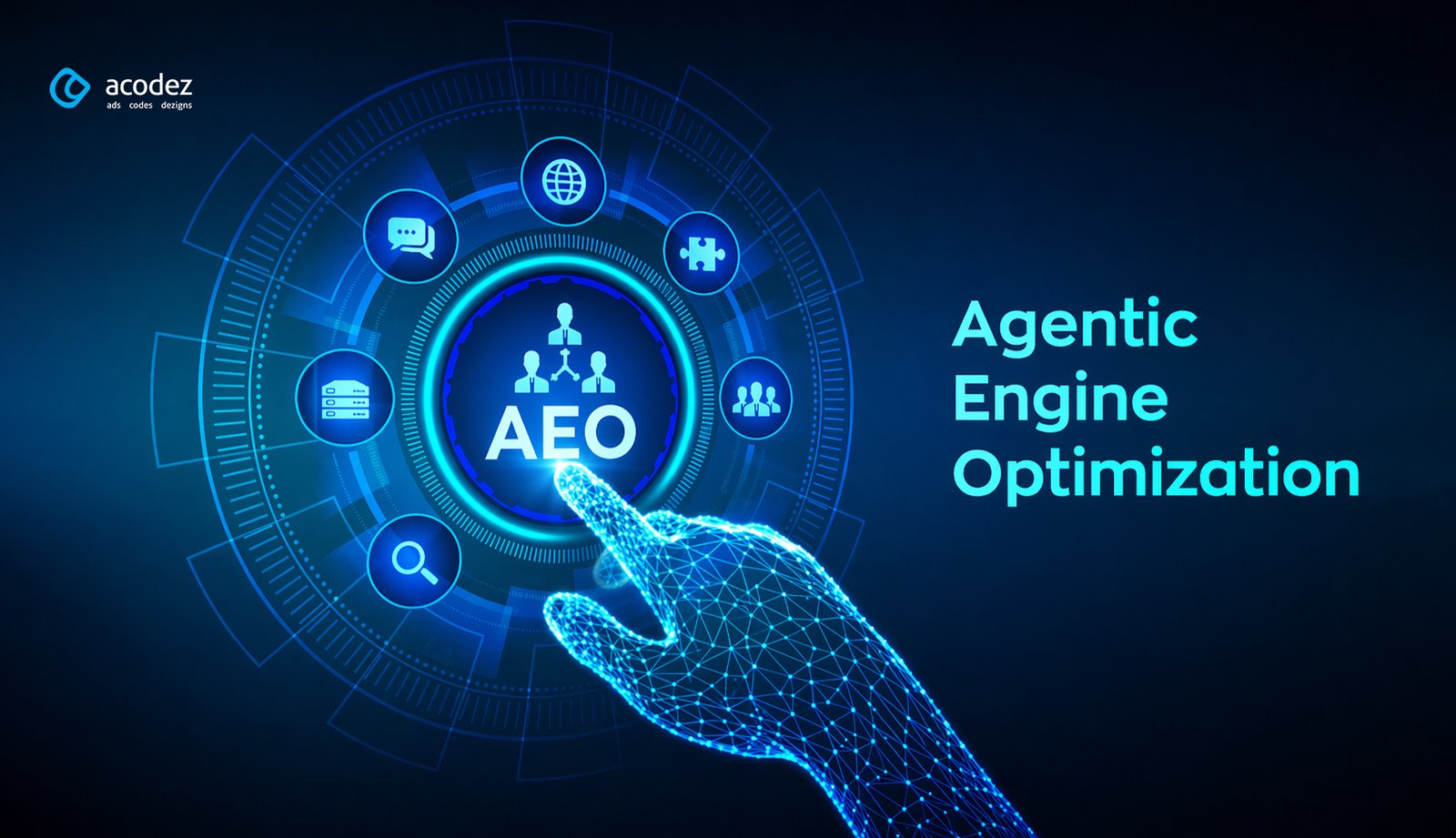
In the evolving world of digital marketing, SEO plays a substantial role in organic visibility, brand awareness, and building a loyal audience. 69% of Google searches in 2025 ended without a click, or Only 46% of Google AI Overview citations come from the top 10 organic results. The rapid change in SEO during the era of AI has marketers claim Agentic Engine Optimisation to be the future of SEO. In simple terms, the rapid spike in AI use and reliance has prompted SEO to not just rank but also be fetched by AI. This has become a trend and a necessity for relevance and for meeting the ideal outcome of SEO. Today, we will uncover the definition of AEO (Agentic Engine Optimization), how AEO differs from SEO, and the files and signals it uses. AEO monitoring practices, Steps to implement AEO, and a checklist to look out for while implementing AEO.
In simple terms, AEO, or Agentic Engine Optimization, is SEO but optimized for AI. It involves the same practices as in SEO, but with added practices, which include structuring your website in order for AI agents to fetch your website’s webpage or content. The goal here is to make the AI discover, understand, parse, and recommend your content seamlessly. You have to make the content comprehensible for both AI and humans. This is crucial as the king of search engines, Google itself, states that the AI and its features still rely on the fundamental SEO principles to provide an answer to users,r and don’t require any special optimization for AI overviews.
Agentic Engine Optimization (AEO): The practice of making your content machine-readable and accessible to AI-powered agents.
AI agents: Autonomous software programs that search, evaluate, and act on information for users without requiring step-by-step human input.
Why it matters for digital marketing: AI systems increasingly influence how users discover brands, compare options, and choose services online. Google’s guidance on AI features also reinforces that content quality, clarity, and structured presentation still matter.
For marketers, this is not a replacement for SEO. It is an extension of SEO into a discovery layer where AI systems may summarize, compare, or recommend your content before a person ever clicks through. That is why AEO is best treated as a visibility layer built on top of strong SEO fundamentals.
Understanding both SEO and AEO might obviously prompt you to ask how AEO differs from SEO. The difference is simple: traditional SEO is designed to help search engines crawl webpages and rank quality results for human searches. Meanwhile, AEO does the same as SEO but for AI systems to easily comprehend, interpret, and recommend. This is relevant in conversational or action-oriented workflows. Google’s structured data docs explain that machine-readable markup helps systems understand page content, while Google’s AI guidance says SEO best practices remain relevant in AI-powered search surfaces.
This shift is also reflected in how users search. The average query length in traditional search is just 3.37 words, while the average ChatGPT prompt is around 23 words, making AI-driven queries far more detailed, intent-specific, and qualified even before users reach a website.
This comparison reflects a practical shift in discovery. SEO still brings humans to the page, while AEO helps machines understand whether your page deserves to be surfaced, cited, or used as a source. The two are complementary, not competing.
How Search Engines Crawl and Rank Content
Traditional search engines crawl pages, index content, and evaluate signals such as relevance, structure, and external references. Google’s documentation also notes that robots.txt is used to manage crawler traffic and that the file must live at the root of the site. In other words, the classic search stack still depends on crawlability, structure, and clear indexing pathways.
How AI Agents Parse and Select Content.
AI agents do not experience content the way humans do. They break text into tokens, operate within context windows, and use structured signals to decide what is relevant enough to summarize or recommend. OpenAI’s tokenizer tool exists specifically to help users understand how text is tokenized, and Google defines a context window as the number of tokens a model can process in a single prompt. Longer or less structured content can be harder for agents to process efficiently.
Why Combining SEO and AEO Matters?
If you only optimize for humans, AI systems may miss the value in your content. If you only optimize for machines, your content may feel thin or unnatural to people. The strongest approach is to create content that is useful to both audiences: clear headings, concise explanations, structured data, and strong topical coverage. Google’s guidance on AI features reinforces that traditional SEO best practices still matter in AI experiences, which makes the overlap between SEO and AEO especially important.
How AI Agents Discover and Consume Your Content
AI agents can only use what they can find and understand. That is why discovery files and machine-readable instructions are becoming more important. The current direction of the web is to make important content easier for models and agents to interpret, not harder. Google’s structured data documentation, OpenAI’s crawler guidance, and the llms.txt proposal all point toward that same machine-readable future. In fact, early adopters of GEO-ready content are being discovered up to 10× faster by generative engines compared to relying on organic SEO alone, highlighting the growing advantage of optimizing for AI-driven discovery.
Discovery through llms.txt and AGENTS.md
The /llms.txt proposal describes a root-level Markdown file designed to help LLMs find a site’s most important content at inference time. It is intended as a simple, predictable file that points models toward the pages, documents, or sections that matter most. AGENTS.md, by contrast, is presented as a simple open format for guiding coding agents, functioning like a README for agents that need context and instructions.
llms.txt: A machine-readable file placed in the root directory that guides AI agents to your priority content.
AGENTS.md: A markdown file that tells agentic systems what your site, repository, or workflow can do and how it should be handled.
In practical marketing terms, these files help you point AI systems to the right content faster. If your homepage is broad but your service pages are more valuable, llms.txt can help prioritize the service pages. If your project or website has specific instructions, AGENTS.md gives agents a place to find them quickly.
Tokenization and Content Parsing
AI systems read content as tokens, not as paragraphs,s in the way humans do. A token may be a whole word, part of a word, or punctuation. The key operational issue is that models work within context windows, so long, bloated, or repetitive content can be truncated or de-prioritized. Google defines a context window as the number of tokens a model can process in a prompt, which is why concise, front-loaded content is easier for agents to use.
Capability Recognition and Recommendation
When AI agents evaluate content, they are looking for signs that a page can answer a query confidently and efficiently. Structured headings, clear topic coverage, schema markup, and machine-readable files all make that easier. Google also says structured data helps systems understand page content and can make pages eligible for richer search appearances, which is a useful signal for both traditional search and agentic discovery.
Many sites are not “invisible” because they lack good content. They are invisible because the content is hard to parse, hard to prioritize, or hard to connect to the user’s intent. In a machine-mediated environment, clarity becomes a practical ranking factor, even if it isn’t officially defined as one. A recent study found that only 46% of Google AI Overview citations come from the top 10 organic results, meaning more than half are sourced from elsewhere, which shows that ranking position alone does not determine which content gets surfaced or cited.
Token Limits and Content Truncation
AI systems have practical context limits. If your article buries the main answer too far down, the model may not reach it in the working window. That is why the most important information should be placed near the top of the page, with strong headings and direct language. Front-loading your value proposition makes your content easier to summarize and recommend.
Missing Machine-Readable Files
If your site has no llms.txt file, no agent-facing instructions, and no structured access rules, AI agents may have to infer too much from the raw page itself. That increases the chance of misinterpretation or missed relevance. Google’s robots.txt guidance also reinforces that crawler access is managed through files placed at the root, and OpenAI documents how GPTBot and OAI-SearchBot can be managed through robots.txt rules.
Unstructured or Poorly Formatted Content
Walls of text, vague headings, and inconsistent formatting are hard for both people and machines. Google’s structured data docs and AI guidance both reward content that is clearly organized and aligned with the visible page. If your page reads like a stream of consciousness, an agent will have a harder time deciding what the page is actually about.
The AEO Implementation Stack for Marketing Teams
AEO works best as a layered system. Start with access control, then add discovery files, then refine the page structure and measurement framework. That gives you a practical rollout path instead of a vague theory.
Access Control with robots.txt for AI
Robots.txt remains the first line of control for crawler behavior. Google says robots.txt is used to manage crawler traffic, and OpenAI’s crawler documentation says site owners can manage GPTBot and OAI-SearchBot separately. Common Crawl also documents its CCBot user agent and explains that it checks robots.txt before crawling.
AI user-agents to consider include:
GPTBot (OpenAI)
OAI-SearchBot (OpenAI search-related crawling)
CCBot (Common Crawl)
If you need to block access, use robots.txt carefully and remember that it is a crawler control mechanism, not a security system. Google explicitly notes that robots.txt cannot guarantee secrecy, and sensitive content should be protected with stronger access controls.
Discovery Signals via llms.txt
The llms.txt proposal recommends a root-level file that points language models toward the most important content on a website. In practice, that means your summary pages, service pages, pricing pages, help documentation, and high-intent landing pages should be easy to identify from the file. Think of it as a machine-friendly shortcut to your best content.
Capability Declarations With skill.md
A skill.md file can be used as a capability declaration: a place to explain what a site, product, or workflow can do for an agent. While the filename and exact format vary across ecosystems, the principle is simple: spell out your capabilities clearly, in plain language, so that agents can match a query to the right page or task. In agentic systems, capability clarity is often as valuable as keyword coverage.
Content Formatting for Agent Parsing
The pages most likely to be understood by AI systems are usually the pages that are easiest for people to scan. Clear formatting benefits both audiences. Google’s structured data guidance also emphasizes that machine-readable markup should match visible content on the page, which means structure and honesty go hand in hand.
Use descriptive headings: Each H2 and H3 should clearly signal what the section contains.
Front-load key information: Place the most important content in the first paragraphs.
Use structured data: Implement schema markup where applicable.
Keep paragraphs concise: Shorter paragraphs improve readability and machine parsing.
Token Optimization Best Practices
Token efficiency is not about writing less for the sake of brevity. It is about removing repetition, using precise language, and making every paragraph do real work. If a paragraph repeats the same point in three different ways, it consumes tokens without adding meaning. Better AEO content is sharper, denser, and more purposeful.
AGENTS.md as the Industry Standard
AGENTS.md is best thought of as an emerging convention for agent instructions, not a finished universal standard. The GitHub project positions it as a simple open format for guiding coding agents and describes it as a predictable place for instructions and context. For marketing teams building agent-ready content pipelines, this makes it a useful pattern to watch and adopt where it fits.
How to Monitor AI Agent Traffic and Measure Impact
AEO is only useful if you can see whether it is working. You need visibility into agent traffic, referral behavior, and downstream conversions. The goal is not just to be discoverable by AI systems; it is to turn that discovery into a measurable business impact.
Identifying AI Agent User Agents
Start by reviewing server logs for known crawlers and agent user-agent strings. OpenAI documents GPTBot and OAI-SearchBot, while Common Crawl documents CCBot and how it identifies itself. Those strings can help you separate human traffic from automated discovery activity.
Configuring Analytics for AI Referral Traffic
Segment AI referrals in analytics where possible. If a request comes through an AI-supported surface, tag it in your reporting workflow so you can compare behavior against organic search, direct, paid, and referral traffic. This helps you understand whether AI-discovered users behave differently and whether they convert at a higher or lower rate.
Attribution Models for AI-Driven Conversions
Attribution in an AI-mediated world is not always linear. A user may first discover you through an AI recommendation, return later through branded search, and convert on a direct visit. That is why multi-touch attribution and cohort analysis are more useful than last-click thinking alone. If AEO helps the first discovery, your analytics should still credit it as a meaningful part of the path.
How to Adapt Your Digital Marketing Strategy for AI Agents
AEO should not be treated as a silo. It belongs inside your broader content, SEO, analytics, and conversion strategy. Google’s AI guidance makes this especially clear: the same SEO fundamentals still matter, and structured, useful content is still the foundation.
Integrating AEO with Existing SEO Campaigns
The easiest way to start is by auditing your best-ranking pages for machine readability. Ask whether each page has a clear headline, a direct answer near the top, useful subheadings, schema where appropriate, and a logical path to the next step. If the answer is no, the page likely needs AEO work 6it is ready for agentic discovery.
Content Strategy for AI Agent Consumption
Create content that answers one primary question well, then extends into related questions in a clean hierarchy. That format serves both human readers and AI systems. Pages built around a single capability, use case, or decision point are much easier for agents to summarize and recommend than broad, unfocused pages.
Brand Positioning in AI-Generated Responses
AI systems tend to reward consistency. If your pages, bios, structured data, and supporting documentation all describe the same offer in the same way, agents are less likely to mischaracterize your brand. Structured data and well-organized visible content reinforce the same story across the web.
AEO Readiness Checklist for Your Website
Use this checklist to assess whether your site is ready for agentic discovery.
llms.txt file created and placed in the root directory
AGENTS.md file implemented with capability declarations
robots.txt updated to address AI crawlers
Content restructured with clear headings and front-loaded information
Schema markup implemented on key pages
Token efficiency reviewed for clarity and concision
AI agent traffic monitoring is configured in analytics
SkillMD file created where relevant to your agent workflow
How to Get Started with Agentic Engine Optimization
Audit your content visibility to AI agents. Review your highest-value pages and confirm they are structured clearly enough for machine parsing. Google’s AI guidance and structured data documentation are good references for this audit.
Implement core AEO files. Create llms.txt first, then add AGENTS.md or a similar instruction file where your workflow supports it. llms.txt and AGENTS.md are both designed to make agent consumption more predictable.
Restructure content for token efficiency. Trim repeated explanations, move the answer higher on the page, and use strong headings. Token efficiency matters because models operate within context windows.
Set up AI traffic monitoring. Track known crawler and agent signals in logs and analytics so you can see what discovery channels are changing. OpenAI and Common Crawl both document their crawler identities and robot behavior.
Test and iterate based on agent behavior. Review which pages get surfaced, which pages get ignored, and where your messaging needs a tighter structure or stronger clarity. Update the pages that matter most first.
The Future of Digital Marketing in an AI-First World
AI-assisted discovery is likely to become a normal part of how people compare services, evaluate products, and choose vendors. Google’s current documentation makes clear that AI features still depend on the same core SEO foundations, which suggests the future is not a replacement of SEO but a deeper integration of human and machine discovery. Brands that build for both will have the advantage.
Predictions for Agentic Search and Discovery
As agentic systems mature, they will likely play a bigger role in product discovery, service recommendations, and task execution. That means brands will need pages that are not only persuasive but also structurally obvious to machines. Files like llms.txt and instruction formats like AGENTS.md are early signals of how the web may evolve around agent consumption.
Skills Digital Marketers Need for AEO
The next generation of digital marketers will need a stronger technical vocabulary alongside creative and strategic skills. The most useful skills will include understanding agent behavior, creating machine-readable content, and measuring AI-driven discovery as a distinct traffic source.
Understanding AI agent architecture and behavior
Technical implementation of machine-readable files
Content structuring for both humans and machines
AI traffic analysis and attribution
Staying current with evolving AEO standards
Why Leading Brands Are Prioritizing AEO Now
Early AEO adoption gives brands a structural advantage. The teams that make their content easier for agents to parse, easier for systems to trust, and easier for AI surfaces to recommend will be better positioned as discovery becomes more automated. That is why the smartest approach is to treat AEO as part of a broader digital marketing system rather than as a standalone experiment. If you want help implementing it alongside your SEO and digital marketing strategy, now is the right time to begin.
Conclusion
In conclusion, implementing SEO in the form of AEO is a must-follow practice in today’s growing era of AI. Failure to do so makes your website fall short of the reach, range,k and potential it deserves. Agentic SEOor AEO is regarded as the future of SEO for certain reasons. The radical change is for the best of both users and web bots, as well as the site owner,r for a smooth and efficient flow of organic online reach and getting what the goal of the websites is for everyone.
Acodez is a leading web development company in India offering all kinds of web development and design solutions at affordable prices.We are also an SEO and digital marketing agency in India, offering inbound marketing solutions to take your business to the next level. For further information, please contact us today.
FAQs about Agentic Engine Optimization
What is the 30% rule in AI content optimization?
The idea is that the most important information should appear in the first 30% of the page so AI systems with limited context can capture it before truncation. It is a practical writing heuristic, not a formal web standard.
Does agentic engine optimization work for local businesses?
Yes. Local businesses can benefit by making their location, services, hours, and capabilities clear in a structured, machine-readable form so AI systems can recommend them more accurately.
Should I prioritize AEO over traditional SEO?
No. The best approach is to protect your SEO foundation while layering AEO practices on top as AI-driven discovery grows. Google’s guidance still emphasizes that SEO best practices matter for AI features.
Which AI agents should I optimize for first?
Start with the AI systems most likely to influence your audience and the crawlers most relevant to your content. OpenAI documents GPTBot and OAI-SearchBot, and Common Crawl documents CCBot, so those are useful starting points for policy and monitoring decisions.
Looking for a good team
for your next project?
Contact us and we'll give you a preliminary free consultation on the web & mobile strategy that'd suit your needs best.
Farhan Srambiyan is a digital marketing professional with a wealth of experience in the industry. He is currently working as a Senior Digital Marketing Specialist at Acodez, a leading digital marketing and web development company. With a passion for helping businesses grow through innovative digital marketing strategies, Farhan has successfully executed campaigns for clients in various industries.