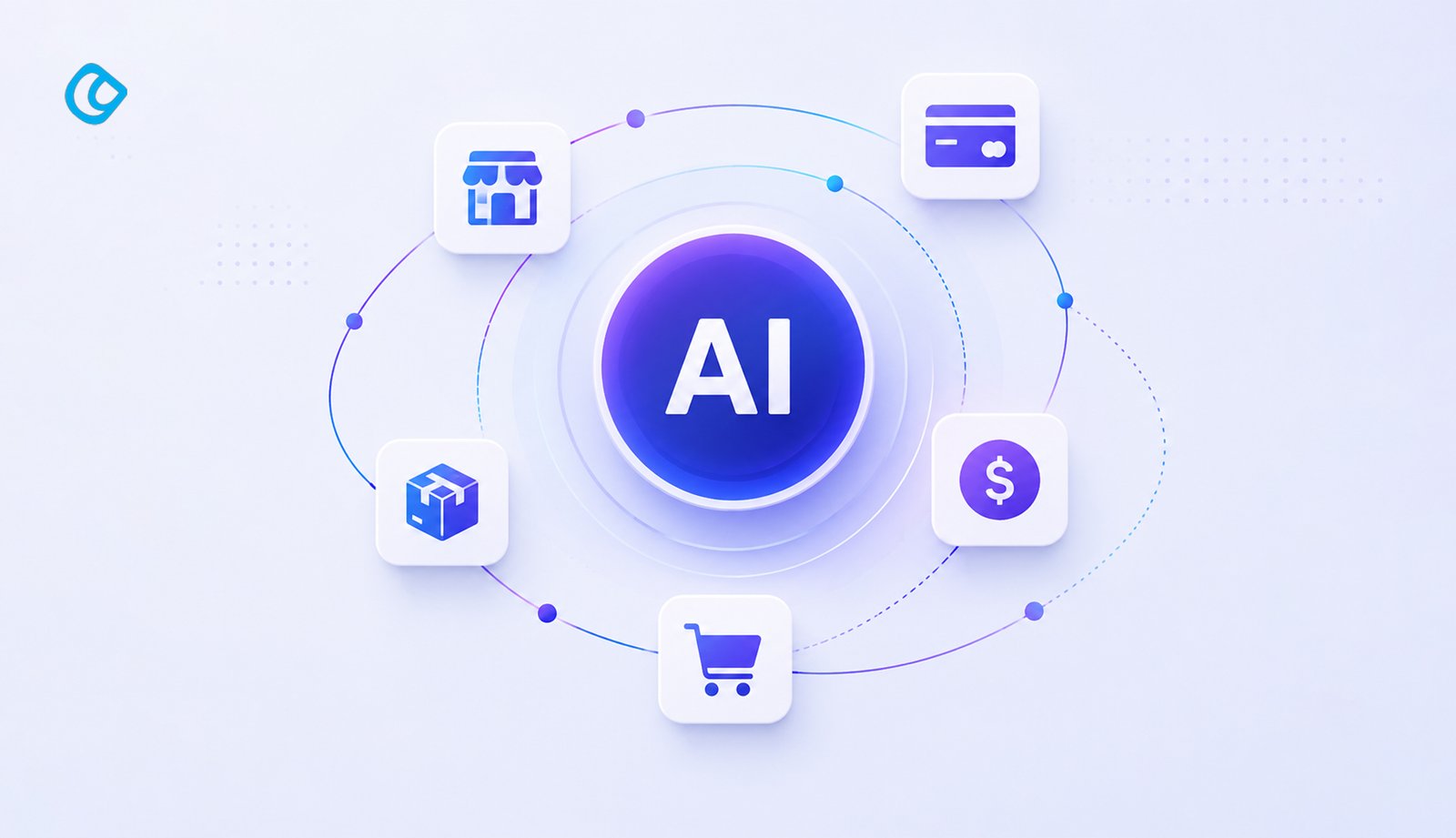
Ranking in Google search results is no longer enough. As generative AI systems like ChatGPT, Perplexity, and Google’s AI Overviews reshape how people discover products, your e-commerce store needs a new layer of optimization: one that makes your inventory machine-readable, agent-ready, and valuable enough for AI systems to cite, recommend, or pull into checkout flows. This is e-commerce AI SEO, and it’s becoming essential for any brand serious about organic discovery in 2026. The shift is already happening. When someone asks ChatGPT “recommend a durable desk chair for a home office,” the model doesn’t return a Google search link. It synthesizes real product recommendations, often pulling details directly from merchant feeds and structured data. When a customer uses an AI shopping agent to compare prices across retailers, that agent reads your product schema, not your website layout. The rules of e-commerce visibility have changed. This guide synthesizes the technical, content, and reputation layers of e-commerce AI SEO into one actionable roadmap. Rather than treating every optimization as equally urgent, we’ll break them into quick wins, medium-term improvements, and advanced plays so your team knows where to start based on your store size and resources. E-commerce AI is becoming the biggest driver of change in how shoppers discover products, and this guide treats it as a natural extension of e-commerce SEO rather than a separate discipline.
E-commerce AI SEO is the practice of optimizing your online store so that AI systems can discover, understand, and recommend your products in AI-generated answers, shopping comparisons, and agentic checkout flows.
It has two core jobs:
Earning visibility in AI-generated answers: When an AI system answers a product-related query, it should cite your products, not a competitor’s.
Making product data retrievable and actionable: Your product information should be structured, complete, and available in formats that AI agents can parse, compare, and act on without visiting your website.
At its core, this is what AI in e-commerce looks like today: machines reading, evaluating, and recommending products on a shopper’s behalf.
You’ll encounter several overlapping terms in industry discussion: AEO (AI engine optimization), GEO (generative engine optimization), LLMO (large language model optimization), and AIO (AI optimization). These terms are used interchangeably, so don’t be confused if different articles use different labels. They all describe the same fundamental shift.
How Ecommerce AI SEO Differs From Traditional Ecommerce SEO
Here’s the good news: e-commerce AI SEO builds directly on traditional SEO fundamentals. Crawlability, site authority, and structured data, the bedrock of search visibility for the past two decades, still matter. AI systems still need to access your site, understand your content, and trust your brand. This overlap is exactly why teams already investing in e-commerce SEO have a head start when they expand into e-commerce AI.
But three genuinely new requirements have emerged:
AI crawler permissions: Beyond Googlebot and Bingbot, you now need to allow and actively encourage crawlers from OpenAI (GPTBot, OAI-SearchBot), Google (Google-Extended for AI Overviews), and other AI platforms. Many security-first configurations block these by default.
Direct product feeds to AI platforms: Unlike traditional search, many AI platforms prefer to receive your product data via direct merchant feeds and portals rather than by crawling your site. The ChatGPT merchant portal, Google Merchant Center, and Perplexity’s merchant program require explicit enrollment.
Protocol-layer connectivity for agentic checkout: Advanced implementations involve direct integrations with agentic commerce protocols (e.g., ACP and UCP) that enable AI shopping agents to complete transactions without leaving their interface. This isn’t essential for most stores yet, but it’s coming.
The first two are must-haves. The third is strategic for high-volume sellers or platform-native storefronts. We’ll return to all three in detail below.
This is where AI in e-commerce becomes concrete, not as a buzzword, but as a set of retrieval mechanics you can optimize for. Understanding how AI discovers and ranks products helps you understand what to optimize for.
AI systems surface brands and products through three channels:
Mentions: The AI system references your product while answering a question, usually in supporting text. Example: “The Autonomous Desk Pro, popular among remote workers, costs around $500.” Your product gets mentioned but not necessarily recommended.
Citations: The system attributes information to your store with a traceable link or reference. Example: “According to Acme Furniture’s product page, the desk includes cable management and a 10-year warranty.” Citations carry more weight because they signal the AI is using your first-party data.
Direct recommendations: The AI explicitly recommends your product as a solution. Example: “For someone on a budget, I’d recommend checking out Acme Furniture’s Basic Desk at $300, with solid construction and good reviews.” Direct recommendations often include a link or integration that sends traffic to your store.
All three depend on retrieval-augmented generation (RAG), the technique most modern AI systems use. RAG works like this: when you ask ChatGPT a question, the system first searches a vast knowledge base (the web, merchant feeds, etc.) for relevant information, then uses that retrieved data to generate an answer. The better your product data matches what the search phase retrieves, and the more complete and structured that data is, the higher the chance your store gets mentioned, cited, or recommended.
This is why structured data and merchant feed completeness matter so much. Well-formatted product information makes the “retrieval” step more efficient and confident, which increases the odds your products appear in the final answer.
Which AI Platforms Matter Most for Ecommerce Stores
Not every AI platform is equally important for e-commerce. Prioritize based on where your customers shop and what platforms drive meaningful discovery and revenue.
Prioritizing platforms this way keeps your e-commerce AI investment focused on channels that actually move revenue.
Store-size guidance:
Small stores (under $500K/year in revenue): Focus on Google Merchant Center optimization and basic schema markup. Skip protocol-level integration (ACP/UCP) for now. Once your feed is clean and complete, add Perplexity’s merchant program if your category has search volume there.
Mid-market stores ($500K–$5M/year): Optimize for Google first, then add ChatGPT merchant portal enrollment. Only pursue ACP or UCP if your transaction volume or platform partnerships justify the development effort. Consider Meta AI if you sell in fashion or lifestyle categories.
Enterprise stores ($5M+ or platform-native): Go all-in across Google, ChatGPT, Perplexity, and Amazon. Invest in protocol integration (ACP/UCP) if you’re on Shopify Plus or have a custom platform capable of agentic storefronts.
The key: start with platform(s) where your customers already exist. Don’t optimize for every platform on day one.
Step-by-Step: Optimizing Your Store for AI Search & Agentic Commerce
1. Audit AI Crawler Access (Quick Win)
Many stores accidentally block AI crawlers through overly restrictive security rules.
Check your robots.txt for AI bot rules:
Look for entries like the following:
User-agent: GPTBot
Disallow: /
If you see this, remove it immediately. You want to allow GPTBot, OAI-SearchBot, and Google-Extended. Same for Perplexity’s bot if applicable.
Check your CDN and WAF rules:
Services like Cloudflare, AWS WAF, and Akamai often have default rules that block unusual bot traffic. Many security teams don’t realize they’re also blocking OpenAI and Google AI crawlers. Request your infrastructure team review rules for GPTBot and Google-Extended specifically.
Enable server-side rendering:
This is non-negotiable. Most AI crawlers don’t execute client-side JavaScript (unlike human visitors with browsers). If your product pages rely entirely on JavaScript to load title, price, or product details, AI systems won’t see them.
Test your site with a simple curl command to verify product pages render server-side:
curl https://yourstore.com/products/example
If you see the full product title, price, and description in the HTML response, you’re good. If you see a loading skeleton, you have a problem.
2. Deepen Your Product Schema (Quick to Medium Win)
Start by auditing your current schema markup. Many stores implement basic product schema (name, price, availability) but miss the rich properties that AI systems use to understand and rank products.
Expand to include:
Brand: Tells the AI who manufactures the product
GTIN / MPN: Standard product identifiers; essential for variant matching across retailers
shippingDetails: Carrier options, costs, estimated delivery times
Has MerchantReturnPolicy: Return window, condition requirements
aggregateRating / review Count: Social proof; AI systems weight reviews as quality signals
color, material, size: Attribute-specific queries like “blue wool sweater in size M”
Product Group: For variant sets (same product in different colors/sizes)
Keep schema and merchant feed data in sync:
This is the single most common mistake. Your Google Merchant Center feed says the product costs $99, but your website schema says $79. AI systems notice. Reconcile these regularly; they should pull from the same source of truth.
Test your schema with Google’s Rich Results Test or Yoast SEO’s built-in schema auditor. Aim for zero warnings.
3. Understand Agentic Commerce Protocols (Advanced; Prioritize by Relevance)
Agentic commerce protocols are the newest layer, and they’re often misunderstood as mandatory. They’re not yet.
MCP (Model Context Protocol): A connectivity layer that lets AI systems (ChatGPT, Claude, others) request live product information from your store. Think of it as an API for AI agents. Useful for high-volume sellers or real-time inventory management, but not essential for most stores.
ACP (Agentic Commerce Protocol): ChatGPT’s checkout protocol. Lets customers buy through ChatGPT’s shopping experience without leaving the app. In beta as of mid-2026, adoption is still early.
UCP (Universal Commerce Protocol): It’s Google’s protocol, co-developed with Shopify, Etsy, Wayfair, Target, and Walmart, endorsed by 20+ partners (Visa, Mastercard, Stripe, Amex, etc.)
WebMCP: A draft standard for web-based MCP. Not production-ready; skip it.
Practical framing for your team:
If you’re a mid-market Shopify store, focus on feed cleanliness and schema first. Protocol-level integration matters more for:
Shopify Plus stores with access to Agentic Storefronts
High-volume sellers who process enough daily orders that stale inventory data risks overselling or stockouts
Brands with white-glove partnerships with major AI platforms
4. Rewrite Product Pages for LLM Readability (Medium Win)
AI systems extract product information differently than humans. What reads well on a landing page might be invisible to an AI.
Never embed specs as an image or in CSS-styled divs. AI systems can’t reliably extract information from images, and they struggle with CSS layouts.
Write for attribute-specific queries:
Customers ask AI for things like “a walnut dining table under $2,000 that seats 8. “Your product page copy needs to address each attribute explicitly:
Before (vague): “Beautiful, timeless dining table perfect for family gatherings and entertaining guests.”
After (specific): A handcrafted walnut dining table, 72 inches long, seats up to 8 people comfortably. Solid walnut construction with hand-oiled matte finish. Price: $1,895. Ships within 10 business days.”
The “after” version includes material (walnut), size (72 inches), capacity (8 people), price, and delivery timeline. When an AI system searches for “walnut table seats 8 under $2,000,” your page matches all the criteria.
5. Build Content That Wins AI Shopping Queries (Medium Win)
Single product pages often underperform for comparative queries. AI systems recommend dedicated content assets like comparison guides or “best for” category pages.
AI shopping queries typically fall into three patterns:
Comparative: “Best office chair for bad backs” → AI looks for roundup content, comparison guides
Budget-constrained: “Good ergonomic chair under $300” → AI favors content that explicitly addresses price tiers
Use-case-specific: “Standing desk for small apartments” → AI seeks content written for that specific situation
If most of your traffic comes from comparative or use-case-specific queries, create dedicated landing pages:
Comparison guides: “Walnut vs. Oak Dining Tables: Which Is Right for You?”
“Best For” category pages: “Best Dining Tables for Small Apartments”
Budget-tier guides: “Quality Dining Tables Under $1,500”
These pages outperform individual product pages for these query types because they give AI systems more context and comparison data to work with.
6. Build Reputation Beyond Your Store (Ongoing)
AI systems cite third-party signals even for branded queries. A customer reviewing your product on Reddit or a journalist mentioning your table in a home-design roundup can boost your brand visibility in AI answers.
Practical tactics:
Use post-purchase review prompts with specific questions, like “What’s the build quality like?” rather than the generic “How would you rate this?” Specific questions get cited more often.
Pitch product roundups proactively: “Our walnut table would be a great addition to your upcoming home office buyers’ guide.”
Monitor competitor mentions in existing roundups and offer your product as an alternative if relevant.
Encourage customer reviews on third-party sites (Trustpilot, Capterra if you’re B2B).
The goal isn’t to game the reviews. It’s to ensure your best customers are visible to AI systems when they’re compiling product recommendations.
How to Measure Ecommerce AI Visibility
The bad news: there’s no built-in GA4 event for “I appeared in a ChatGPT answer.” AI-generated answers don’t create sessions or pixel events, so attribution is hard.
The good news: you can measure manually, and it’s surprisingly straightforward.
Build a prompt library:
Create 20-50 realistic customer-style queries relevant to your products:
“Best standing desk for back pain”
“Ergonomic office chair under $400”
“Wooden dining table that seats 8”
Test across platforms:
Run each prompt through ChatGPT, Perplexity, Google AI Mode, and any other relevant platform. Log whether your store is mentioned, cited, or recommended.
Set a baseline:
If you appear in 3 out of 20 test queries, your baseline score is 15%. After three months of optimization, retest. If you’re up to 9 out of 20, you’ve moved 30%, solid progress.
Track platform-specific tools:
Google Merchant Center now includes “AI performance insights” showing estimated impressions in Google AI Overviews. Monitor this monthly. Perplexity and ChatGPT don’t yet expose their own metrics, but independent tools like Semrush’s AI Visibility or Sistrix are adding e-commerce tracking.
Don’t wait for perfect measurement. Start with manual testing, set a baseline, and measure again in three months.
Common Mistakes to Avoid
Treating all AI platforms as equally urgent. Your store probably doesn’t need ACP or UCP integration on day one. Start with Google and one other platform where your audience concentrates.
Letting product schema and Merchant Center feed data drift. Schedule a monthly audit to ensure your website schema, feed, and inventory are in sync. Mismatches confuse AI systems.
Publishing single product pages for comparative queries. If a lot of your traffic comes from “best X for Y” queries, dedicate content pages to those queries instead of assuming product pages will rank.
Assuming FAQ schema still earns a rich snippet. Google deprecated FAQ rich results in May 2026. FAQ-formatted content is still valuable for LLM chunk retrieval, but don’t implement FAQ schema expecting a search feature snippet.
Ignoring server-side rendering. If your product pages load entirely via JavaScript, most AI crawlers won’t see them. This is a blocker, not a nice-to-have.
Overlooking third-party reputation. A single Reddit comment recommending your product might be cited by ChatGPT. Build reputation signals beyond your website.
Conclusion
E-commerce AI SEO is not a future concern. It’s happening now. ChatGPT shopping is live in beta. Google AI Overviews are surfacing product recommendations. Customers are using AI agents to comparison-shop and check out. The good news is that the foundational work- product schema, merchant feeds, and site crawlability overlap heavily with traditional SEO. You’re not starting from zero. You’re building an additional optimization layer on top of what’s already working. Start with crawler access, follow with schema and feed optimization, then layer in reputation-building and content strategy. Agentic commerce protocols will matter more over time, but they’re not your day-one priority unless you’re a high-volume seller or platform-native storefront. Your competitors are moving on this now. The stores that invested in clean feeds, complete schema, and third-party signals in 2026 will own AI-generated product discovery in 2027. E-commerce AI SEO is ultimately about making e-commerce AI and e-commerce SEO work together instead of as separate line items on a roadmap. Start today.
Acodez is a leading web development company in India offering all kinds of web development and design solutions at affordable prices. We are also an SEO and digital marketing agency in India, offering inbound marketing solutions to take your business to the next level. For further information, please contact us today.
FAQ
Do I need separate optimization for ChatGPT shopping vs. Google AI Overviews?
Mostly, no. Both platforms benefit from the same foundation: complete product schema, clean merchant feeds, and strong third-party signals. The differences are enrollment-specific. ChatGPT requires merchant portal signup and potentially ACP integration; Google requires merchant center enrollment. The schema and content work translate across both.
How long does it take to see results from e-commerce AI SEO?
Crawler access and schema fixes can show up within 2-4 weeks. Reputation-building and citation tracking usually take 2-3 months to show meaningful movement. Don’t expect overnight results. This is similar to traditional backlink-building timelines.
Is agentic commerce (UCP/ACP) relevant for small Shopify stores yet?
Only if you’re on Shopify Plus and have access to their experimental agentic storefront features. For standard Shopify stores, clean feeds and schema should come first. ACP and UCP integration will become more accessible as the standards mature, but they’re not essential in mid-2026.
Can I track AI visibility for free?
Yes. Build a prompt library, test manually across ChatGPT, Perplexity, and Google, and log mentions and citations in a spreadsheet. Paid tools (Semrush AI Visibility, Sistrix) add automation and competitor tracking, but manual testing is a valid starting point.
Does e-commerce AI SEO replace traditional SEO?
No. It’s an additional layer on top of crawlability, site authority, and on-page fundamentals. You still need fast page load times, mobile-friendly design, and authoritative backlinks. AI SEO doesn’t replace traditional SEO; it adds to it.
Looking for a good team
for your next project?
Contact us and we'll give you a preliminary free consultation on the web & mobile strategy that'd suit your needs best.
Farhan Srambiyan is a digital marketing professional with a wealth of experience in the industry. He is currently working as a Senior Digital Marketing Specialist at Acodez, a leading digital marketing and web development company. With a passion for helping businesses grow through innovative digital marketing strategies, Farhan has successfully executed campaigns for clients in various industries.