Imagine surfing web pages in late 2026: online marketplaces with the appearance of Airbnb carbon copies, software workstations with the lines of Linear straightness, portfolios reduced to bare-bone navigation. It is efficient, all right, with a load time of less than two seconds, bouncing reduced, and SEO set to algorithmic precision. But it’s also soul-crushing. Depending on the feeds generated by AIs on TikTok and Instagram, users need friction, the unexpected, a burst of the unforeseen. Designers, too, are restless. In a viral thread in the X group, one of the creative members decries the whole web moving into a bland, repetitive design approach, as Material Design and its descendants of the flat UI design language became the embodiment of imitation over innovation. Post-minimalism is the cure: a mixture of minimalism with all the maximalism bravado. The clarity of the former is amplified with the glows of the latter, the organic intrusions of 3D, and typography that dances as the viewport. It is a comeback of the maximalist web, when more is more is no longer clutter, it is catharsis.
This shift isn’t accidental. The floor has been raised and leveled with AI tools as Midjourney and the generative plugins of Figma, which generate minimalist templates in a few seconds. What was considered an art of refinement is screaming default. According to one X user, AIs will commoditize flat design; interfaces of high detail and craftsmanship will become conspicuous. Boring is out, beautiful is in.” In 2026, maximalism will not be retro, it will be rebellion – how the brands show humanity in the world where machines can simulate perfectly but are deeply vacuous. We shall unravel the way we came here and where we are going.
To comprehend post-minimalism, we must confront the iron fist of minimalism in web design. Minimalism was introduced to the digital world in the early 2010s, fueled by the mobile-first demands and the emergence of responsive frameworks such as Bootstrap, which offered salvation in a crowded digital wild west. This was the time of endless scroll feeds and pop-up ads, graphic designers such as Jony Ive at Apple and Material at Google were the architects of minimalism as a revolution. Straight, clean, a lot of white space, monochromatic color palettes, these did not just happen to be aesthetics; these were performance hacks. Faster load times, intuitive navigation, and improved conversion rates made minimalism irresistible. By 2020, a significant majority of users favored this approach, with 78% of users saying they prefer clean designs because they create a sense of calm amid digital chaos.
Jump to the middle of the decade: minimalism was solidified. What started as form follows function, turned into form is function, and whole industries followed suit with the same typeface headers, ghost buttons, and hero images of stock models staring at their horizons with a pensiveness. E-commerce sites? Indistinguishable. SaaS landing pages? Interchangeable. Even the luxury brands, which at one time had been selling opulence, knelt down to the shrine of austerity the location of Chanel as bare as the cell of a monk. The logic behind this was unquestionable: in an attention economy where users have 8.25 seconds to interact, simplicity is the winner.
Yet, cracks formed. It is not what was reflected in the analytics, the concealed price: affective alienation. Users skipped, clicked, converted, but never lingered. Bounce rates concealed a more underlying vice: apathy. Minimalism is no longer a trend; it is the distinction between appearing like an actual company and appearing like a pet project, and even the author of X acknowledges just how sterile the style is. The format failed in industries where the stories are more significant than the transactions, such as the fashion industry and media. The online versions of Vogue were chained; the indie creators were rubbing against the monotheism. By 2024, they were talking about so-called aggressive minimalism, where designs were so minimalized that the brand had been forgotten, and the site was no longer recognizable.
Minimalism was not created through artificial intelligence, but its proliferation was boosted by it, and it psychocybernetically planted its own grave. During the age of AI, applications such as Adobe Sensei, Uizard, and v0.dev generate wireframes and entire websites within mi qnutes and fall back to minimalistic tropes, which are trained on a century of flat design. Indie developer Pieter Levels, who has made his sites by hand in order to make them look like every other site, with their clunky and intense design, is making more than 125K a month, specifically because they defy the conventional. As nearly 93% of web designers now use AI tools in their workflows, and 58% rely on AI specifically to generate unique imagery and media assets, the result has been a flood of sameness, gradients of sterility, predictable cards, and emotionless grids. With 90% of new web projects now AI-aided, according to Gartner projections, homogenization has become the dominant aesthetic risk.
This homogenization reached its climax in 2025. Since AI is taking on the what of design – layouts, responsiveness – human beings regain the why – evoking feeling, establishing a connection. In the age of AI, individuals will appreciate something quirky, a bit human, says a design director at X. Maximalism is good in this, as it uses AI not to copy but to amplify. The generative tools currently render layer-based textures, changing gradients, and custom illustrations at scale, which were too labor-heavy to be used in the past. The vivid glow of Midjourney reminds me of yielding neon-drenched heroes; the 3D figures at Spline are not bloated with any depth. The result? Websites that are loaded quickly (with optimized AI resources) but breathe life.
The time is appropriate geopolitically and culturally. After the pandemic, users are seeking happiness in the face of uncertainty; Gen Z and Alpha, as digital natives accustomed to the kinetic feeds of TikTok, do not buy into the corporate boringness. The 2025 projections made by Pinterest highlight maximalist accents as the cure-all to sterile homes and grey cars. AI makes it even worse: with algorithms shaping our realities, maximalist designs are breaking the veil, and they need something to be paid attention to with their extreme contrasts and rich narrative. It is a kind of post-minimalism at work: minimal basics overloaded with maximal blooms, a synthesis in which the technology allows a glut of excess without any weight.
Defining Post-Minimalism: Maximalism Reimagined
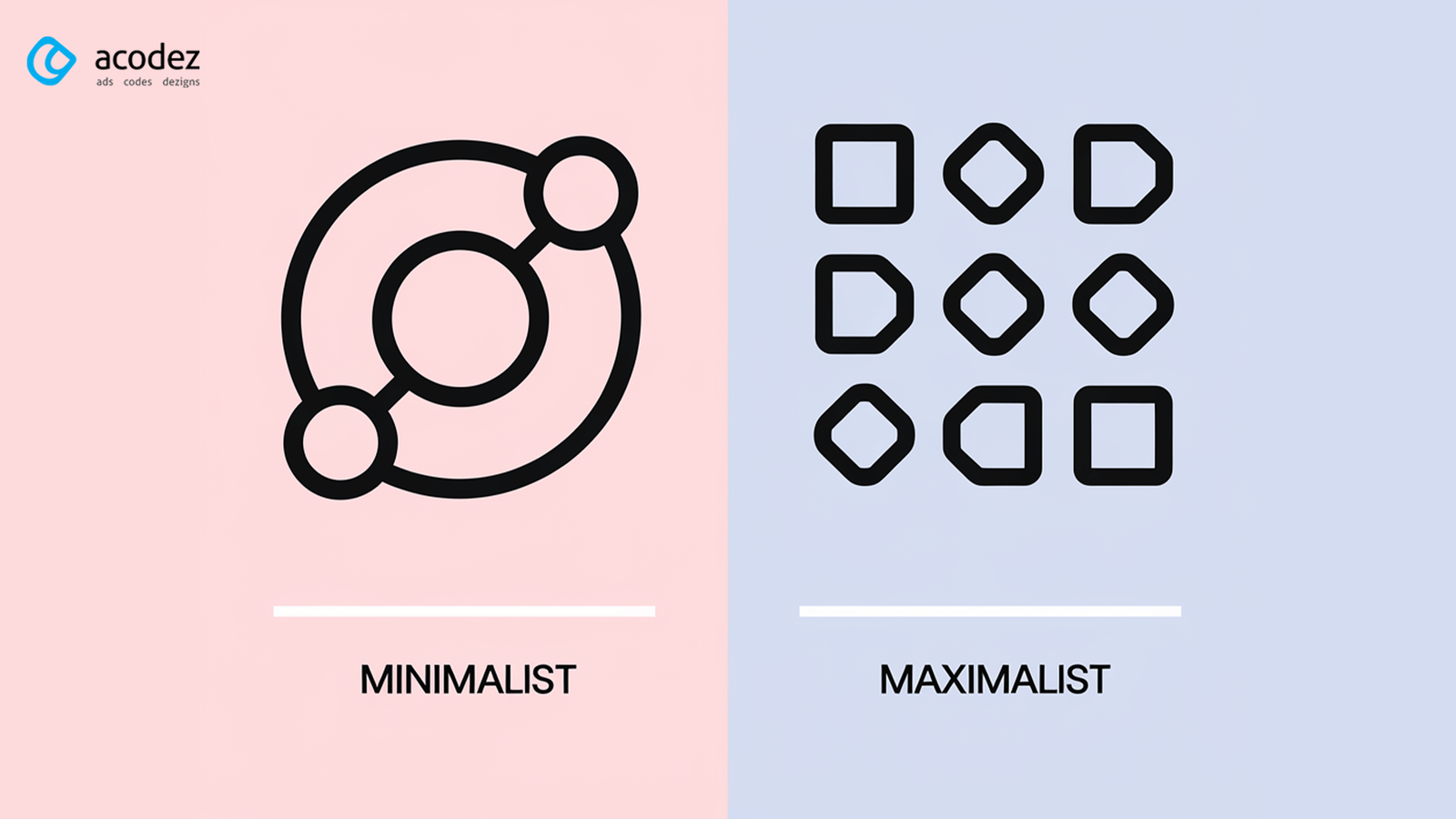
Minimalism Vs Maximalism – image source: zoho.com
Post-minimalism is not the vulgar revitalization of maximalism; imagine the GeoCities fever-dream of blinking GIFs and MIDI music. Neither is it the shyness of minimalism, nor micro-animations, as the corresponding trophies. It is an artificial combination: the science of less offering framework to the outburst of more. Its most popular principles are layered images (vivid patterns on top of the plain grids), emotional typography (huge serifs in conflict with a sans), and interactive content (scroll-based reveals that open like pop-up books). Ideally, it is the campaign pages of Gucci: theatrical, personality-driven experiences that, according to UX analysts, make people feel like it is an occasion.
Something aesthetically, anticipate minimalist maximalism, which is bare canvases with bursts of color: a scanty e-commerce superhero with 3D blooms of products, or a SaaS dashboard with monochromatic serenity broken by glowing, AI-intelligent icons. It is functional in that it puts accessibility first, readability with high contrast palettes, voice navigation to create immersion, but it is opulent without making it off-putting. The integrations in Webflow, such as Rive and Framer, with AI prototypes, are scalable, and what took weeks is now iterated within hours.
The philosophy is simple: in an AI-saturated landscape, delight becomes the differentiator. As industry observers note, the defining design trend of 2026 is “Minimalist Structure + Maximalist Personality,” a hybrid approach that is powering the highest-converting websites of the year. Echoing this shift, entrepreneur Greg Isenberg predicts the return of personality in digital design. Post-minimalism honors the clarity of minimalism while breaking its monotony, creating experiences that convert not just clicks, but emotions as well.
Case Studies: Tribal Magic: Maximalist Magic in the Wild.
Theory ignites in execution. Look at Squarespace’s template Organic Matter: a post-minimalist gem that combines whitish minimalism with maximalist intrusions of nature vines crawling all over, 3D flora sprouting in the hover hover. Engagement is increased by 25 per cent as reported by users on the site, a human high-five overcomes AI chill. Or the portfolio of Or Adrian Rusnac: vigorous brutalism diluted by maximalist overlays of type and attracting 40 per cent more inquiries as such.
Indie rocket Hard Anime Shirts breaks every rule with looping video heroes and clashing color palettes, yet sales have climbed 35% in an otherwise minimalist market, proving that retention can be art-driven. Even enterprise players are evolving: Mysten Labs’ site overlays AI-generated crypto visuals onto fluid user flows, increasing dwell time by 50%. These are not anomalies; they are early signals of a broader shift. Design-driven companies, often those embracing distinctive, maximalist aesthetics, have outperformed the S&P 500 by 219% over 10 years, reinforcing the idea that bold design doesn’t just attract attention, it delivers sustained business performance.
The use of Post-Minimalism: Tools and Best Practices.
Ready to maximize? Then begin with AI, not autopilot. Cut ready high-quality stuff with Midjourney, and adjust in Figma with its Dev Mode. Client applications such as Tailwind make it possible to do quick prototyping, although inject intent: specify what prompts what parameters: saturated future, disco-ro trip vibe of the 70s. Best practices: Be anchor with limited navigation (icons on hamburgers are turned into animated icons); be full of movement (GSAP-enabled level of parallax depth); be test monkeys (A/B maximalistic variants in case of engagement peaks).
Challenges? Pitfalls of performance: When to use PNG instead of JPG; pitfalls resurrecting accessibility; Let WCAG run amok (in theory). Budgeting to iteration: post-minimalism is based on feedback loops, in which an AI proposes, and humans iterate. In 2026, tools such as Framer AI and generative fills in Webflow make it less exclusive and allow solopreneurs to build a bespoke beauty without the need for teams.
By 2026, post-minimalism will take over, with 60 per cent of the sites having a combination of maximalist accents, according to Forrester. AI becomes more imitative than inspirational: smart interfaces that change depending on mood (through sentiment analysis), AR superimposition on the tactile maximal. The voice and gesture navigation further increases the layers, how about sites talking stories? Sustainability restrains overindulgence: eco-optimized makes carbon low. The web turns into a picture of contradictions, efficient and extravagant, simple and symphonic, in which AI is the grind, humans the genius.
The malpractice of messy maximalism is lamented by critics as AI backlash gone wrong. However, statistics are opposed: maximalist sites experience 30 per cent share growth, as users desire the “artisanal” in automation. The future is not meagre; it is rosy.
Summing up: Take the Overboard.
The term post-minimalism is an indicator of the emancipation of web design: decades of minimalist monasticity are succeeded by a period of maximalist debauchery offered by the AI age. It is not about overwhelming, but about opening the eyes; creating places people can remember, share, and build relationships on. We are in the age of maximalism, as one of the visionaries observes. Monochrome layouts are out. Cozy, humanistic settings are out of fashion. Designers, brands: scan your pixels. Stake off all that is unnecessary, then overlay the glowing. The algorithmic avalanche of 2025 is the one in which the sites that rise to the surface and prosper are the ones that dare to be more beautiful and unapologetically so.
Acodez is a leading web development company in India offering all kinds of web development and design solutions at affordable prices.We are also an SEO and digital marketing agency in India offering inbound marketing solutions to take your business to the next level. For further information, please contact us today.
Frequently Asked Questions
Should I redesign my minimalist site to post-minimalism?
Consider if bounce rates exceed 45% or dwell time is under 2 minutes. Maximalist designs boost engagement 30% for creative sectors, but test first via landing pages. B2B/SaaS often prefers hybrid approaches (Notion: -40% bounce) over full maximalism.
How do I avoid bland AI-generated designs?
Use specific prompts like “70s disco maximalism” or “theatrical luxury textures.” Generate assets with Midjourney/Figma AI, then layer manually. 90% of designers customize AI output; indie devs earn $125K+ monthly by defying templates.
Will post-minimalism hurt SEO and load times?
No, with optimization (WebP images, lazy loading, minified code). Core Web Vitals remain achievable. Mysten Labs gained 50% dwell time without SEO loss. Pages over 4s load lose 46% users – optimize assets regardless of style. accessibility standards.
How to balance post-minimalist creativity with UX?
Build a minimalist base (clear navigation/CTAs), layer visuals incrementally. Use heatmaps, A/B tests, and session recordings to validate. WCAG ensures clarity; remove decorative elements failing the “why is this here?” test.
Post-minimalism vs. clutter – what’s the difference?
Post-minimalism uses intentional hierarchy (3-5 colors, clear typography scale); clutter lacks purpose. Test with screen readers – if hierarchy/navigation remains clear, it’s post-minimalism. Every element must guide, evoke emotion, or inform
Looking for a good team
for your next project?
Contact us and we'll give you a preliminary free consultation on the web & mobile strategy that'd suit your needs best.
Rithesh Raghavan, Co-Founder, and Director at Acodez IT Solutions, who has a rich experience of 16+ years in IT & Digital Marketing. Between his busy schedule, whenever he finds the time he writes up his thoughts on the latest trends and developments in the world of IT and software development. All thanks to his master brain behind the gleaming success of Acodez.