Multi-cloud and hybrid cloud are often used interchangeably, but they describe two different architectures, and the distinction matters more than the vocabulary. Multi-cloud means running workloads across two or more public cloud providers, such as AWS and Google Cloud. “Hybrid cloud” means combining private or on-premises infrastructure with one or more public clouds as a single connected system. Get this choice wrong, and you pay for it in three ways: higher cost, weaker compliance control, and slower scaling.
This guide breaks down the multi-cloud vs hybrid cloud difference in plain terms, then gives you a comparison table, real-world use cases, a decision framework, and the tools you need to run either model well. It closes with short, citation-ready answers to the questions teams most often ask before committing to a cloud strategy.
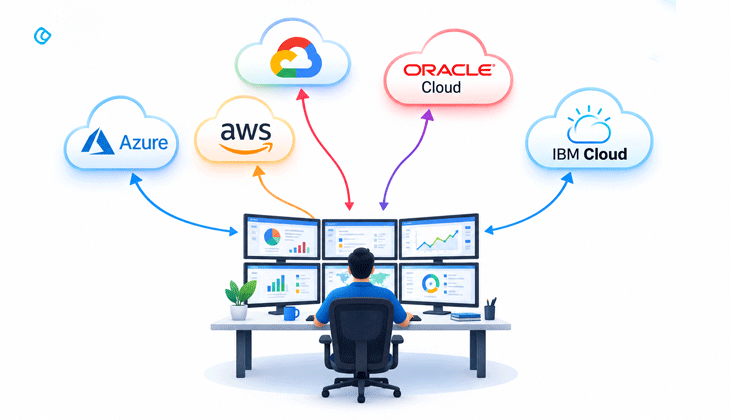
Multi-cloud is the use of cloud services from more than one public cloud vendor at the same time. In practice, this usually means running enterprise applications on infrastructure from two or more providers, such as Amazon Web Services (AWS), Microsoft Azure, Google Cloud Platform, or IBM Cloud, side by side. The appeal is straightforward: spreading workloads this way protects performance, keeps costs competitive across providers, and stops any single vendor from dictating pricing or terms.
Three characteristics define a deliberate multi-cloud strategy. First, best-of-breed selection: you pick the strongest service from each provider for each workload rather than accepting one vendor’s version of everything. Second, the workloads do not need to interconnect; your analytics environment on one cloud can run independently of your compute environment on another. Third, single-vendor dependency falls away, which is the core hedge behind the approach.
A concrete example makes this clearer. A company might run its core application servers on AWS, use Google Cloud’s machine-learning tools for its recommendation engine, and serve static content through a specialist CDN. Each provider is chosen because it is best at that specific job.
One line worth stressing: multi-cloud is a deliberate multi-vendor strategy, not accidental sprawl. If teams have quietly signed up for different clouds over the years without coordination, that is shadow IT, not a multi-cloud strategy.
What is a Hybrid-Cloud?
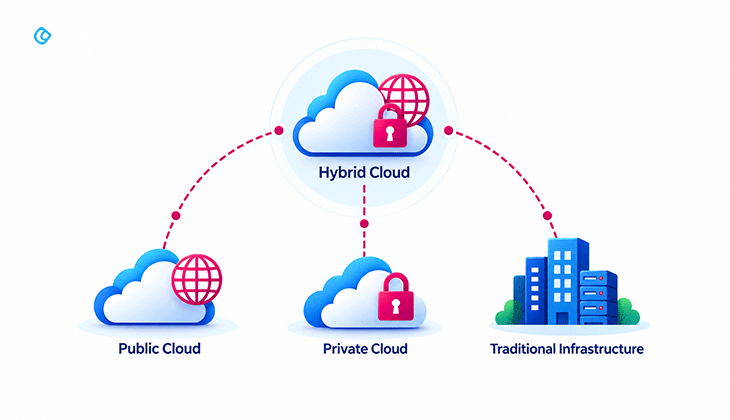
A hybrid cloud combines private cloud or on-premises infrastructure with one or more public clouds, working together as one connected system. The defining feature is that workloads and data can move between the private and public environments, so the two operate as a single architecture rather than two isolated islands.
The core trade-off explains why the model exists. Private infrastructure gives you control and compliance; data stays where you can govern it directly. Public cloud gives you scale and elasticity; capacity you can turn up and down on demand. Hybrid cloud is how organizations get both at once.
A practical example: a business keeps sensitive customer records and core databases in its own data center, while its web-facing services, load balancers, and burst capacity run in the public cloud. When traffic spikes, the public cloud absorbs the extra load; when demand falls, that capacity is released and the bill drops.
This interconnection is the key architectural difference from multi-cloud. Multi-cloud environments are often siloed; each public cloud runs independently. Hybrid cloud is integrated; private and public resources are connected through consistent networking, identity, and management so data and workloads flow between them. It’s a selling point across the major providers, AWS, Azure, and Google Cloud, each of which markets hybrid tooling that promises the same management console and controls whether a workload sits in the public cloud, in your own data center, or out at the network edge.
Multi-Cloud vs Hybrid Cloud: Key Differences
At the highest level, multi-cloud answers a question about how many public vendors you use, while hybrid cloud answers a question about mixing private and public infrastructure. The table below lays out the differences dimension by dimension, and it is the quickest way to compare the two models side by side.
Dimension
Multi-Cloud
Hybrid Cloud
Core definition
Two or more public clouds from different providers
Private/on-premises infrastructure + one or more public clouds
Primary goal
Best-of-breed services, avoid vendor lock-in
Balance control/compliance with public-cloud scalability
Integration
Often siloed, clouds don’t need to interconnect.
Deeply interconnected, workloads and data move between environments.
Vendor lock-in risk
Low, spread across providers
Moderate, tied to private infrastructure plus one or more public providers
Data control
Depends on each public provider’s controls
Sensitive data can stay on-prem/private for tighter control.
Management complexity
High, multiple consoles, APIs, and security tools
High integration and consistent policy across environments
Typical cost driver
Per-provider usage + cross-cloud data transfer fees
On-prem capital cost + public cloud operating cost
Best fit for
Redundancy, geographic reach, specialized services per workload
Two rows deserve more than the table can carry. Vendor lock-in is the headline reason teams choose multi-cloud: by spreading workloads across AWS, Azure, and Google Cloud, no single provider can dictate pricing or terms. The catch is that portability is rarely free; each provider’s managed services come with proprietary hooks, so true portability usually requires standardizing on open tools like Kubernetes and Terraform rather than provider-specific shortcuts.
Cost is where the models diverge sharply. Hybrid cloud carries on-premises capital costs, servers, power, cooling, and the team to run them, alongside public cloud operating costs. Multi-cloud avoids that capital spend but adds cross-cloud data transfer (egress) fees and the overhead of paying for overlapping tools. Neither model is automatically cheaper; the honest answer is that hybrid favors predictable, long-lived workloads, while multi-cloud favors flexibility and short-term agility.
Can a Cloud Strategy be both Hybrid and Multi-Cloud?
Yes. This is one of the most common points of confusion, and the two terms answer different questions, so they can overlap. “Hybrid” describes the type of infrastructure, private plus public. Multi-cloud describes how many public vendors you use. A company can be hybrid, multi-cloud, both, or neither.
A “hybrid multi-cloud” setup is common in practice. A company might keep its core database on a private cloud, which makes it hybrid, while simultaneously running AWS for compute and Google Cloud for analytics, which makes it multi-cloud. The private layer provides control, and the two public clouds provide choice and resilience. Flexera’s 2026 State of the Cloud Report found that 73% of surveyed organizations already operate hybrid estates, with multi-cloud adoption still climbing year over year, evidence that real-world architectures are converging on this combined pattern rather than picking one model exclusively.
Cost-efficient backup and disaster recovery. Replicating data to a second provider means an outage or account issue at one vendor does not take your business down.
Resilience against single-provider downtime. Spreading workloads reduces the blast radius of a regional failure or a provider-wide incident.
Specialized services per workload. One provider may lead in AI/ML tooling, another in content delivery, and another in data warehousing. Multi-cloud lets each workload run where it is strongest.
A representative example is a media company that uses one provider for content delivery, a second for viewing analytics and machine-learning-based recommendations, and a third for backend integration, each chosen for its strengths, with no single vendor holding the whole platform.
When Hybrid Cloud Makes Sense
Regulated industries. Banks, insurers, and healthcare providers often must keep certain data on private infrastructure for compliance, even while other workloads run in the public cloud.
Existing on-premises investment. If you recently invested in data center capacity, hybrid lets you extend that investment instead of writing it off in a full migration.
Cloud bursting. Seasonal or traffic spikes are handled by temporarily extending on-premises workloads into the public cloud, then scaling back, cheaper than permanently over-provisioning your own hardware.
A representative example is a video platform that runs its compute and recommendation engines in the public cloud while keeping content-creation and editing infrastructure on-premises, moving only what is safe and sensible into the cloud over time.
How to Choose a Decision Framework
Most “which cloud strategy” articles stop at definitions. Here is a simple decision framework instead. Start by asking four questions:
What are our data sensitivity and compliance requirements? If regulation forces certain data onto private infrastructure, hybrid is the default answer.
What existing infrastructure do we already own? A recent on-premises investment favors hybrid; a clean slate favors starting lean.
What is our budget model, capital or operating spend? Hybrid adds capital cost up front; multi-cloud is almost entirely pay-as-you-go operating cost.
How mature is our in-house cloud operations team? Multi-cloud multiplies consoles, APIs, and policies. A small team may struggle to run it safely.
Map your situation to the matrix below.
Business situation
Recommended strategy
Why
Startup or SME, no legacy infrastructure, cost-sensitive
Multi-cloud (or start single-cloud)
No on-premises capital cost; pay-as-you-go keeps upfront ₹/US$ spend low.
Regulated data (BFSI, healthcare, government)
Hybrid cloud
Sensitive data stays on private infrastructure for compliance while other workloads scale on the public cloud.
Existing on-premises data center investment
Hybrid cloud
Extends and protects existing investment instead of a costly rip-and-replace migration
Needs best-in-class AI/ML, analytics, or niche tooling per workload
Multi-cloud
Let each workload run on the provider best suited to it.
Small in-house IT team, limited cloud ops maturity
Hybrid cloud (managed) or single cloud
Multi-cloud’s multi-console overhead is hard to run without a dedicated cloud ops function.
The pattern is consistent: compliance and legacy push you toward hybrid; agility and specialization push you toward multi-cloud. If you are not sure where your situation lands, Acodez’s cloud consulting and DevOps team runs this assessment with you, mapping your compliance constraints, existing infrastructure, and team capacity to a strategy you can actually operate, not just one that looks right on a slide.
Tools and Platforms for Managing Multi-Cloud and Hybrid Environments
The honest challenge of both models is management. Here are the tool categories that keep complexity under control, with examples. The categories matter more than any single vendor’s product, so choose per category rather than betting everything on one suite.
Category
Example tools
Purpose
Cloud management platforms (CMP)
VMware Aria, Red Hat OpenShift, HPE GreenLake
Single-pane visibility and control across environments
Infrastructure as Code
Terraform, Ansible, Pulumi
Consistent, repeatable deployments across providers
Security & compliance
CSPM/CWPP tools (e.g., Wiz, Prisma Cloud)
Detect misconfigurations, enforce policy across clouds
FinOps / cost management
CloudHealth, Kubecost, native billing dashboards
Track and optimize spend across environments.
Observability
Datadog, Dynatrace, Grafana
Unified monitoring, logging, and tracing
Kubernetes has become the de facto control plane underneath most of these tool categories: 82% of container users now run Kubernetes in production, up from 80% in 2024 and 66% in 2023.
Common Mistakes to Avoid
These are the failures that show up most often when a cloud strategy is chosen on trend rather than on requirements, and the list is worth reading before you commit, because each one is expensive to reverse.
Assuming multi-cloud is automatically more secure. It multiplies the number of security consoles and policies you must configure consistently. More clouds without more governance is more attack surface, not less.
Adopting hybrid cloud without a data integration and migration plan. The result is fragmented, hard-to-govern data split across environments.
Underestimating cross-cloud egress costs. Architecting for multi-cloud without pricing data transfer between providers is a common source of bill shock.
Choosing a strategy on trend, not on requirements. Compliance needs, budget model, and in-house skills should drive the decision, not what a conference keynote called the future.
Skipping centralized management and observability until complexity is unmanageable. By the time you need the single pane of glass, retrofitting it is far harder than building it in from day one.
Conclusion
The choice between multi-cloud and hybrid cloud is not an absolute either/or. It depends on your compliance requirements, your existing infrastructure, and your team’s maturity, and many organizations end up running both at once. Hybrid is the answer when control, regulation, or legacy systems dominate; multi-cloud is the answer when agility, resilience, and specialized tooling do.
If your team is weighing this decision, Acodez’s cloud consulting and DevOps team can assess your specific setup and recommend the architecture that fits your business and, just as importantly, help you operate it. Get in touch to start that conversation.
Acodez is a leading website design and web development company in India. We offer all kinds of web design and web development services to our clients using the latest technologies. We are also a leading digital marketing agency providing SEO, SMM, SEM, Inbound marketing services, etc at affordable prices. For further information, please contact us.
What is the main difference between multi-cloud and hybrid cloud?
Multi-cloud uses two or more public cloud providers, such as AWS and Google Cloud, usually without those environments needing to connect. A hybrid cloud combines private or on-premises infrastructure with public cloud services, working together as one integrated system. The difference is architectural: multi-cloud is about how many public vendors you use; hybrid cloud is about mixing private and public infrastructure.
Can a business use multi-cloud and hybrid cloud together?
Yes. A “hybrid multi-cloud” setup is common , a company might keep sensitive data on a private cloud (hybrid) while also using two or more public providers such as AWS and Microsoft Azure for different workloads (multi-cloud). The two strategies describe different aspects of an architecture and are not mutually exclusive.
Which is more expensive: multi-cloud or hybrid cloud?
Hybrid cloud typically has a higher total cost of ownership because it requires investing in and maintaining on-premises infrastructure alongside public cloud spend. Multi-cloud usually costs less upfront since there is no private infrastructure to build, though cross-cloud data transfer fees can add up. Exact figures depend on current provider pricing, so model your own workloads rather than relying on a single published number.
Is multi-cloud more secure than hybrid cloud?
Neither is inherently more secure. Hybrid cloud allows sensitive data to stay on tightly controlled private infrastructure, which helps with compliance. Multi-cloud spreads risk across providers but requires consistent security policies across multiple consoles, which is harder to manage. Security depends more on implementation and governance than on which model is chosen.
What is cloud bursting?
Cloud bursting is a hybrid cloud technique where workloads normally running on private or on-premises infrastructure temporarily shift to the public cloud when demand spikes beyond on-prem capacity, for example, during a seasonal sales peak. It’s a cost-effective way to handle short-term surges without permanently over-provisioning private infrastructure.
Will multi-cloud or hybrid cloud dominate enterprise IT in the future?
Flexera’s 2026 State of the Cloud Report, based on a survey of 753 cloud decision-makers, found 73% of organizations already operate hybrid estates, a three-point increase year over year, while multi-cloud adoption continues to rise. The trend is toward “hybrid multi-cloud” architectures that combine private infrastructure with multiple public providers for flexibility, resilience, and compliance.
Looking for a good team
for your next project?
Contact us and we'll give you a preliminary free consultation on the web & mobile strategy that'd suit your needs best.
Farhan Srambiyan is a digital marketing professional with a wealth of experience in the industry. He is currently working as a Senior Digital Marketing Specialist at Acodez, a leading digital marketing and web development company. With a passion for helping businesses grow through innovative digital marketing strategies, Farhan has successfully executed campaigns for clients in various industries.